


A World of Pandas...
2025 Panda Coins
Denominations and mintages:
1kg Gold, 10,000 Yuan, mintage 1,000
150 gm Gold, 20600 Yuan, mintage 5,000
100 gm Gold 1500 Yuan, mintage 20,000
50 gm Gold 800 Yuan, mintage 40,000
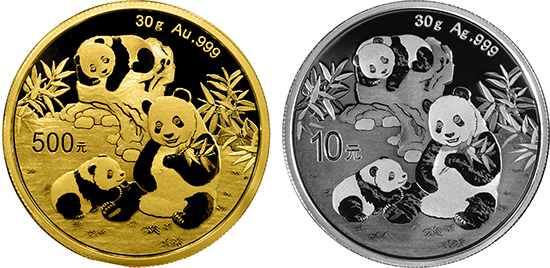
30 gm Gold, 500 Yuan, mintage 1,000,000
15 gm Gold, 200 Yuan, mintage 200,000
8 gm Gold, 100 Yuan, mintage 200,000
3 gm Gold, 50 Yuan, mintage 500,000
1 gm Gold, 20 Yuan, mintage 500,0001kg Silver, 300 Yuan, mintage 10,000
150 gm Silver, 50 Yuan, mintage 30,000
30 gm Silver, 10 Yuan, mintage 10,000,00030 gm Platinum, 1000 Yuan, mintage 10,000
1 gm Platinum, 100 Yuan, mintage 20,000
The Panda Coin That Nobody Knew
There are Panda coins that make headlines and Panda coins that don’t. For instance, the kickoff for the approaching year’s Pandas is always a big deal. Last November, the 2018 Panda Launch was held at the Hyatt Regency Hotel across the street from the Beijing International Coin Expo. To get to the Hyatt from the China National Convention Center, there’s no need to walk outside in the cold; a covered bridge connects the two buildings. The Panda Launch ceremony, complete with dance routines, videos and prizes, always draws a crowd and news media...(Continued on NGC)
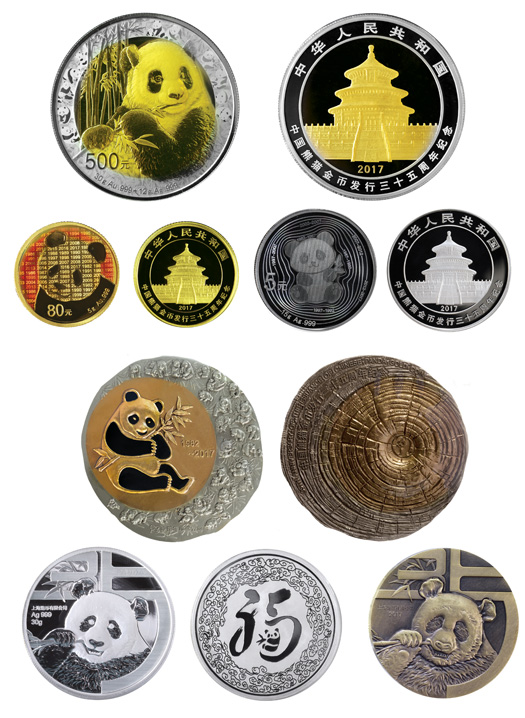
2017 35th Anniversary Pandas
The Panda Cubs of Chengdu
Black and white and happy all over, two baby Giant Pandas roll and tumble across the leaf-strewn playground. Awww! A crowd presses up against the enclosure railing. Less than 50 feet (15 meters) away one cub climbs on top of its companion. Over they go! Then the pair bumps up against a small, flat-topped pile of rocks. No matter, they scramble up the obstacle and continue their game.
Cell phones and cameras blaze away as another Giant Panda cub skootches up a tree. He (or she, who can tell?) finds a branch to rest on and is then marooned, unable to continue up, unsure of how to get down. The little bear gives the onlookers a forlorn look that elicits another round of ooohs and aaahs.
These playful cubs are around 5 months-old. They may even be siblings, something that would never occur in the wild. Pandas can give birth to more than one baby, but the mother can only care for one. At birth Giant Pandas weigh only around 100 grams, or 4 oz. The hairless, blind infants cannot even move on their own and rely on Mom for everything.
If two are born, the mother will choose the more robust infant and abandon the other. At the Chengdu Research Base of Giant Panda Breeding in south-central China, however, those extra babies are placed in incubators. The tiny pink Panda bears get names and are skillfully nursed along by the staff. (Continued - more photos and story)

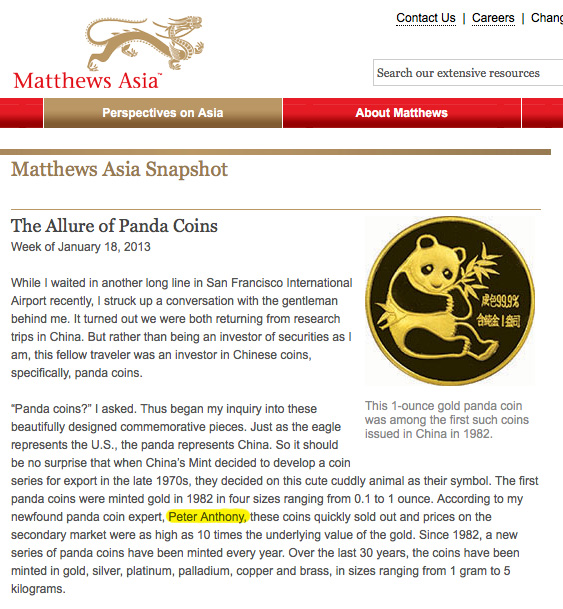
Asia Weekly Features Panda coins and Peter Anthony
Asia Weekly is a publication of Matthews-Asia. Matthews-Asia is the largest private company dedicated solely to Asian investments in the United States. It manages assets in excess of $19 billion.
Pandaology 101
I taught a college anthropology class about Chinese coins (mainly Pandas and Lunars) and how they are intertwined with China's history, culture and economy. Talk about fun! The regular professor said it was the best guest lecture of the year. The students were really attentive and responded to stories like the one about how the Temple of Heaven is connected to the Winter Solstice. They asked me questions like how long have mints made collector coins and are there any coins to commemorate the return of Hong Kong to China, plus dozens more. Afterward the professor told me that one student who hadn't spoken aloud in class the entire semester had asked 4 questions. The future of coin collecting is bright — especially when it includes Pandas!
Items of Interest
Panda Blood May Hold Potent Assailant Against Superbugs
Panda Blood May Hold Potent Assailant Against Superbugs
Researchers have discovered a powerful antibody in panda blood that could serve as the next frontier in the fight against increasingly prevalent superbugs. Read moreChina Panda Virus Kills Two Pandas, Leaves Third in Critical Condition
(International Business Times January 16, 2015) "Another giant panda in China is fighting for its life as it battles a highly infectious virus that has already cliamed the lives of two others."
Summary: The Canine Distemper Virus (CDV) is a relative of measles. It is reported to be the leading cause of infectious disease death in dogs. It also affects other mammals like Pandas for which there is no vaccine. It is spread through contaminated food, water and body fluuids. The fatality rate among Pandas is 80%.
Panda Breeding Centers in China like the Chengdu Panda Base have implemented emergency procedures to protect their wards. This includes increased disinfection of panda living areas and reduced contact with the public.